


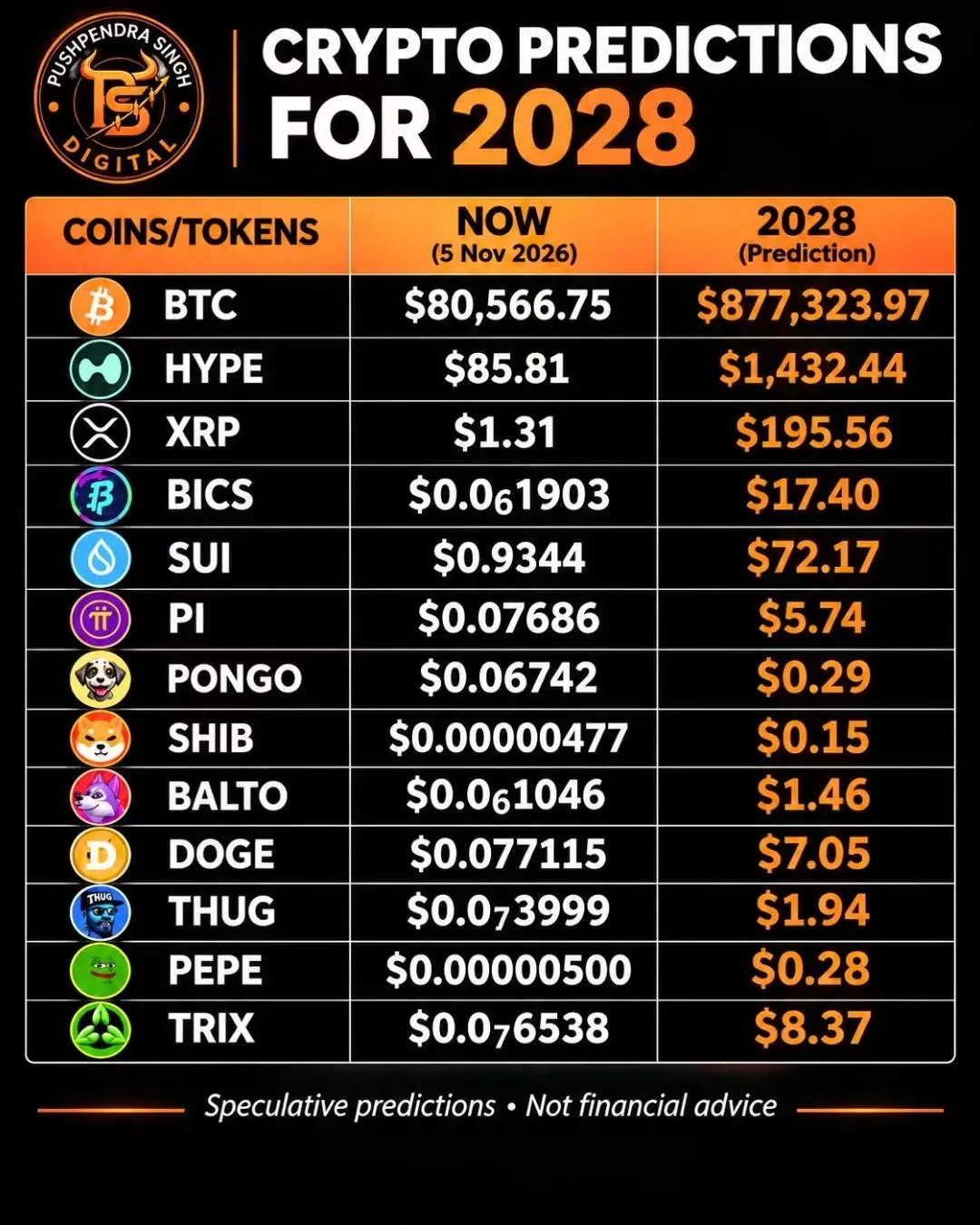
Bitcoin $BTCUSD at $877,000 by 2028? This isn’t a prediction, it’s a lottery ticket
Various predictions about where Bitcoin will be in a few years are circulating online. One made me laugh: one Bitcoin is supposed to jump from about $75,700 today to $877,000 by 2028. I worked out what that would mean (data as of 6. 11. 2026).
📌 PRICE ISN’T THE WHOLE STORY More important than the price of one Bitcoin is its market capitalization. That’s the price of one Bitcoin multiplied by the number of all Bitcoins in circulation—in other words, the value of all Bitcoins combined.
There are about 20.1 million Bitcoins in circulation today. 20.1 million × $75,700 = a market capitalization of about $1.52 trillion.
By the end of 2028, there will be about 20.4 million Bitcoins in circulation. At a price of $877,000, the market capitalization would have to be about $17.9 trillion. So Bitcoin’s value would have to grow by about $16.4 trillion in two years. That’s almost 12 times.
📌 WHAT THAT MEANS IN PRACTICE $17.9 trillion is more than the combined market value of Apple, Nvidia, Microsoft, and Google (about $17 trillion altogether)—the four largest companies in the world.
These companies built their value over decades and make billions in profits. Bitcoin would have to overtake all of them at once, in just 24 months.
📌 WHAT HISTORY SAYS: GROWTH Bitcoin moves in four-year cycles based on the halving. Market capitalization used to grow enormously from the bottom to the top of a cycle, but less with each cycle:
✅ 2015 bottom → 2017 peak (from about $2 billion to $329 billion): more than 100 times ✅ 2018 bottom → 2021 peak (from $57 billion to $1.28 trillion): about 22 times
✅ 2022 bottom → 2025 peak (from $297 billion to about $2.5 trillion): about 8 times
The bigger something is, the harder it is to multiply its size. A small sapling can grow by half in a year. A century-old oak can’t.
📌 WHAT HISTORY SAYS: DECLINES Every peak was followed by a decline. Those, too, have been getting smaller with each cycle:
❌ 2013 → 2015: −87%
❌ 2017 → 2018: −84%
❌ 2021 → 2022: −77%
❌ 2025 → 2026: deepest so far, −54% (summer 2026)
Bitcoin is still about 40% below its October 2025 high of $126,198.
📌 WHAT THIS MEANS Bitcoin is maturing. It’s bigger, institutions have entered the market, and it no longer moves as wildly as it used to. Smaller declines are good news.
But that works both ways. Smaller declines also mean smaller gains. Growth has fallen from 100 times to 22 and then to 8. This prediction now calls for a 12-fold increase in two years—more than Bitcoin managed over the entire last four-year cycle, when it was several times smaller.
And one more fact: Bitcoin first exceeded a value of $1 trillion in February 2021. More than five years have passed since then, and its all-time high was about $2.5 trillion. This prediction calls for $17.9 trillion in two years.
📌 FOR OTHER COINS, IT’S EVEN MORE ABSURD The same prediction promises:
$XRPUSD 149 times higher
$DOGEUSD 91 times higher
$SHIBUSD 31,000 times higher
With $SHIB, $100 would turn into $3.1 million. In two years. For a coin with no revenue or profit.
📌 WHY THIS IS DANGEROUS Anyone who believes a prediction like this invests with unrealistic expectations. When a downturn comes and the price doesn’t rise as expected, they’re disappointed and often sell at a loss.
The problem isn’t investing. The problem is expectations.
📌 WHAT’S A REALISTIC EXPECTATION The U.S. stock market index S&P 500 has returned an average of around 10% a year since 1957. That’s a good long-term average, not a guarantee for every year. Anyone who can consistently beat that average over the long term is among the world’s best investors.
For comparison:
✅ S&P 500 at 10% a year: about +21% over 2 years
❌ Bitcoin prediction: about +1,076% over 2 years
At a rate of 10% a year, a 12-fold increase like that would take about 26 years. This prediction expects it in two.
Anyone expecting more than 1,000% in two years isn’t investing. They’re playing the lottery.
The point is simple. Before investing in anything, understand what you’re investing in and what you can realistically expect from it.
This isn’t investment advice. I’m sharing how I check predictions before believing them.