


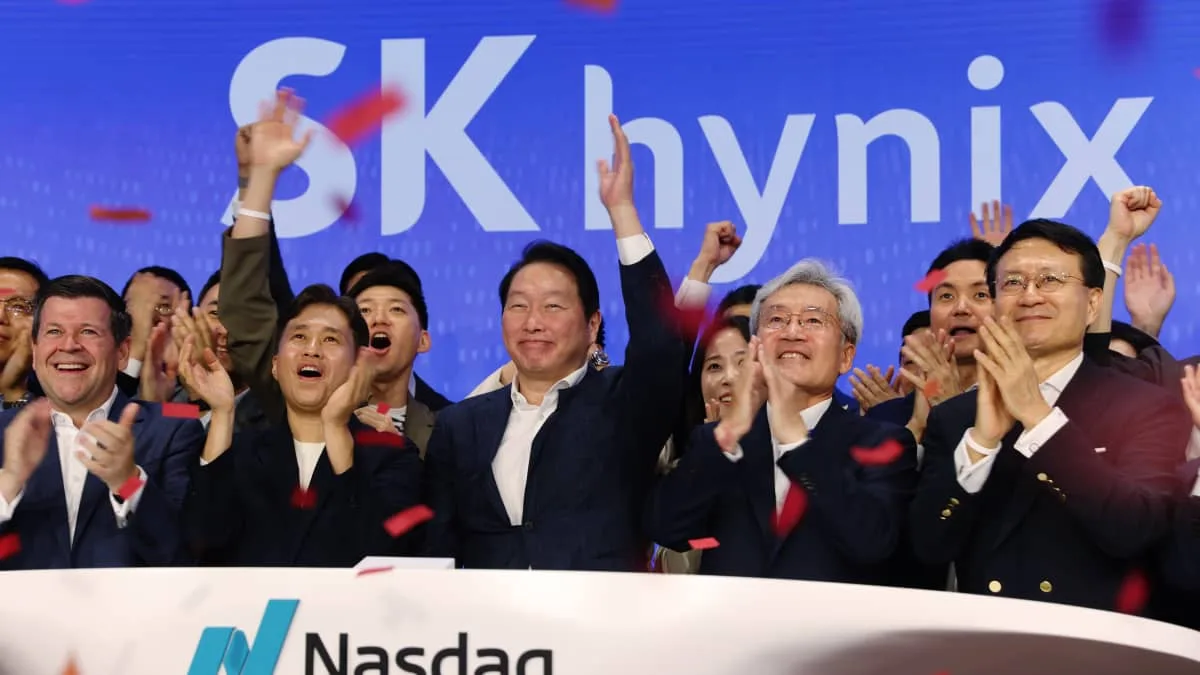
SK Hynix $SKHY - earnings report analysis
Fundamentally, this is one of the strongest reports in semiconductor history. Revenue topped 100 bil. KRW for the first time, operating margin was 80%, and results significantly beat estimates.
Capacity is sold out through 2029, and the company will return ~100 bil. KRW (~$75 bln) to shareholders.
Weak spots: Most of the growth is driven by prices, not volume. Net income fell 58% due to one-off losses. Capex will rise significantly in 2027, and the market fears we are near the peak of the cycle.
What investors will probably like:
A big beat and record margins. An 80% operating margin at a memory maker is historically unprecedented; even TSMC is around 50%.
Sold-out capacity: Long-term contracts with 14 key customers cover over 50% of capacity for 2027–2028. They include Nvidia, Microsoft, and Amazon.
According to the company, DRAM and HBM are “effectively sold out through 2029,” and the shortage is expected to last until 2030.
HBM4 is ramping up: Full-scale production began in Q3, and yields are above plan (target raised).
In Q4, HBM4 is expected to surpass HBM3E in both volume and revenue.
HBM4E samples are already with customers, and custom HBM is being developed with major customers.
Outlook: Q4: DRAM shipments +20-29 % NAND +4–6 %
2027: Revenue and profit “significantly higher than in 2026,” with DRAM demand up roughly +25 %, and NAND demand around +17-19 %.
Returning capital to investors (FY2026) 100 bil. KRW ($75 bln):
Dividends of at least 30 bil. KRW. For Q3, that amounts to 20 000 KRW per share, half of it special.
Buybacks of at least 60 bil. KRW, including 40 bil. KRW already completed.
This fulfills the company’s promise to return over 50 % of FCF.
What to watch:
Growth is mainly driven by prices. Roughly 3/4 of DRAM revenue growth came from prices (DRAM prices +25-29 %, NAND +24–26 % q/q). DRAM volume rose 10%, while NAND volume actually fell slightly. Price is exactly what turns around fastest in a memory cycle.
Net income -58 % q/q. This was caused by foreign-exchange losses of 11,6 bil. KRW and investment write-downs of 22,9 bil. KRW.
The special dividend comes from a one-off gain on the investment in Kioxia. It cannot be relied on regularly.
Capex will rise significantly in 2027, but the company did not give a figure. Samsung and Micron are also building. The main long-term risk is excess capacity in 2028–2029.
Customers are moving to lower HBM “stacks” (fewer layers per chip). Management says this is due to the shortage and does not change its demand outlook.
Prices in long-term contracts are not fixed. They move within an agreed range based on the market, so they will fall too if the market declines.
Dependence on AI capex. Meta and Google have negative FCF. If hyperscalers slow down in 2027, pricing pressure will hit memory first.
Valuation:
At a share price of around 1,39 mil. KRW, market capitalization is roughly $750 bln.
Annualized Q3 operating profit is ~333 bil. KRW (~$250 bln), so P/E comes to roughly 4× earnings based on the current run rate.
Net cash of ~$70 bln and $75 bln returned this year imply a shareholder yield of ~10 % of market value.
Such a low multiple is typical for memory stocks at a cycle peak: the market does not believe these margins will last.
Market reaction:
Korea: shares rose as much as +9,4 % during the day.
ADR (SKHY): in the US, after the close, +6 % to $154. Last week, they fell 8 % in a chip sell-off. The 52-week range is $125–200, so they are still ~23 % below the high.
My overall view:
Short term (2026–2027), it looks great: sold-out capacity, HBM4 leading the pack, rising prices, even higher profit in 2027, and massive buybacks.
Medium term (2028+), there are questions: Will AI capex hold up? How much capacity will Samsung and Micron add? Will prices turn around sooner than the company says?
The stock trades like a cycle peak (4-5× earnings). If management is right and the shortage lasts until 2030, it looks pretty cheap. But if the cycle turns in 2028, profits could be cut in half in a year... and a rough patch will follow :D