Why Are Brazilian Stocks Falling, and How Will It Affect Your Portfolio?

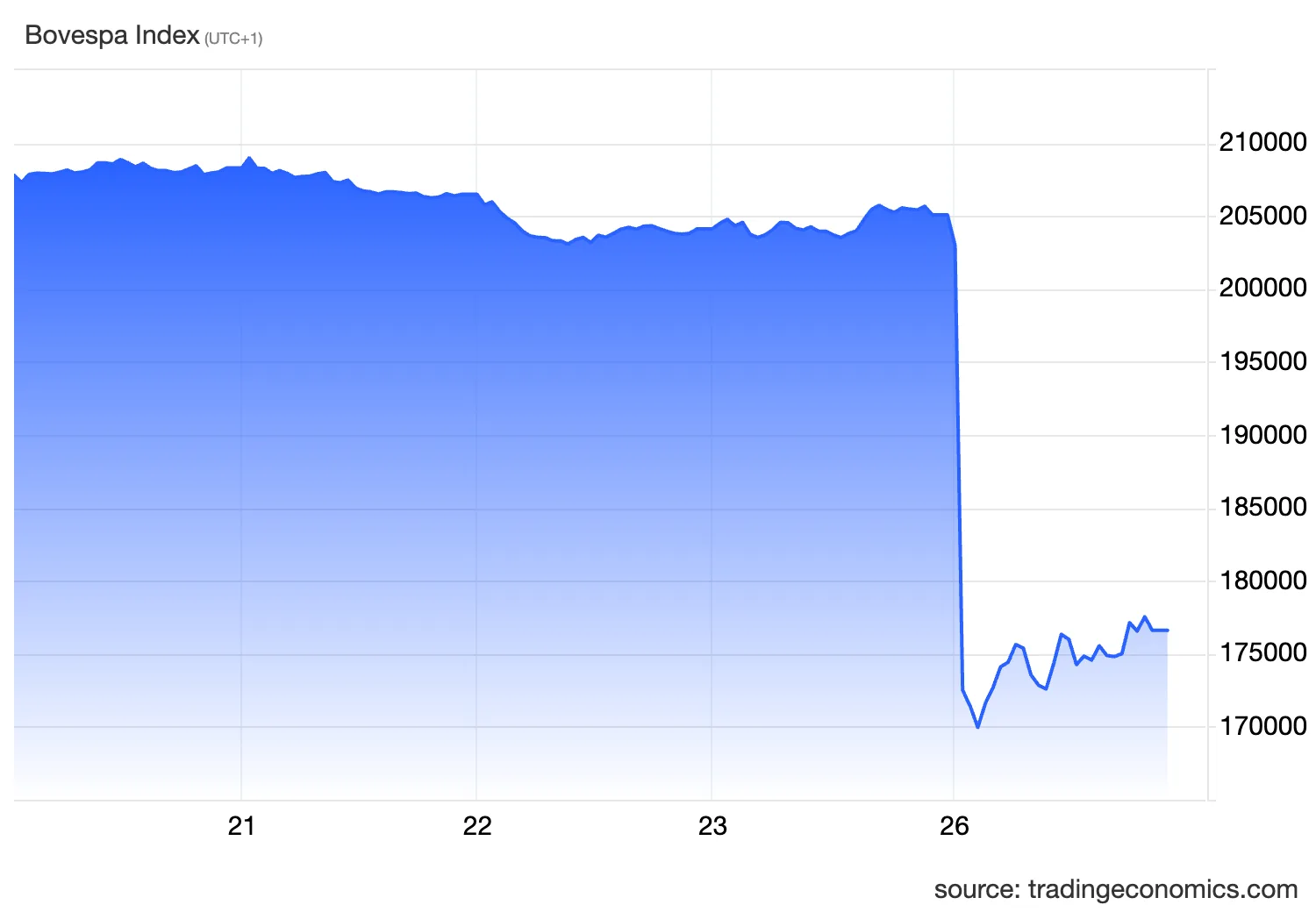
On Monday, Brazil’s stock exchange plunged 13.9%. The Ibovespa index fell as much as 17% during the day, and the exchange had to halt trading for 30 minutes. The real lost nearly 9% against the dollar. It was the worst day since the COVID crash in March 2020.
What happened? 🇧🇷
In Sunday’s presidential runoff, Lula won reelection. He defeated Flávio Bolsonaro by 51.8% to 48.2%. Bolsonaro had won the first round, and the market had bet on his victory. From mid-September until the election, the Ibovespa rose about 25%.
Why did it hurt so much? 📉
Stocks fell because the market had priced in a scenario that didn’t materialize. Investors expected spending cuts and business-friendly reforms. Instead, they got the continuation of a government expected to increase spending and run up debt.
Banks took the biggest hit (Bradesco $BBD -21.7%, Itaú $ITUB -13.7%), along with companies that depend on the domestic economy. The Finance Ministry canceled government bond auctions, and interest rate futures surged. A weaker currency will make imports more expensive and fuel inflation. The central bank then won’t be able to cut interest rates, which are already at 14%.
History rhymes here. When Lula first won in 2002, the market panicked in much the same way and the real collapsed. Lula then governed pragmatically, and Brazil experienced one of the biggest bull markets of the decade. It may not turn out that way this time, but panic on election day isn’t the best indicator of what will happen over the next five years.
What this means for U.S. and European stocks
The good news: almost nothing. The S&P 500 gained 0.7% on Monday, and the Nasdaq rose 0.8%. The DAX and STOXX 600 both finished only slightly down. The contagion stayed in Latin America, with Chile and Colombia losing around 1.5%.
Brazil is too small to move Wall Street on its own. But I’m keeping an eye on companies with substantial business in Brazil. In Europe, that includes Santander $SAN and AB InBev, which owns Ambev $ABEV (down nearly 8% on Monday). A weaker real will eat into their earnings when converted.
For a U.S. portfolio, Wednesday and the Fed matter more this week. The market expects rates to stay in the 3.75-4.00% range. But a strong dollar puts pressure on all emerging markets. If the Fed surprises with a hawkish tone, Brazil may not be the last to take a hit.
What happened to the Brazilian real
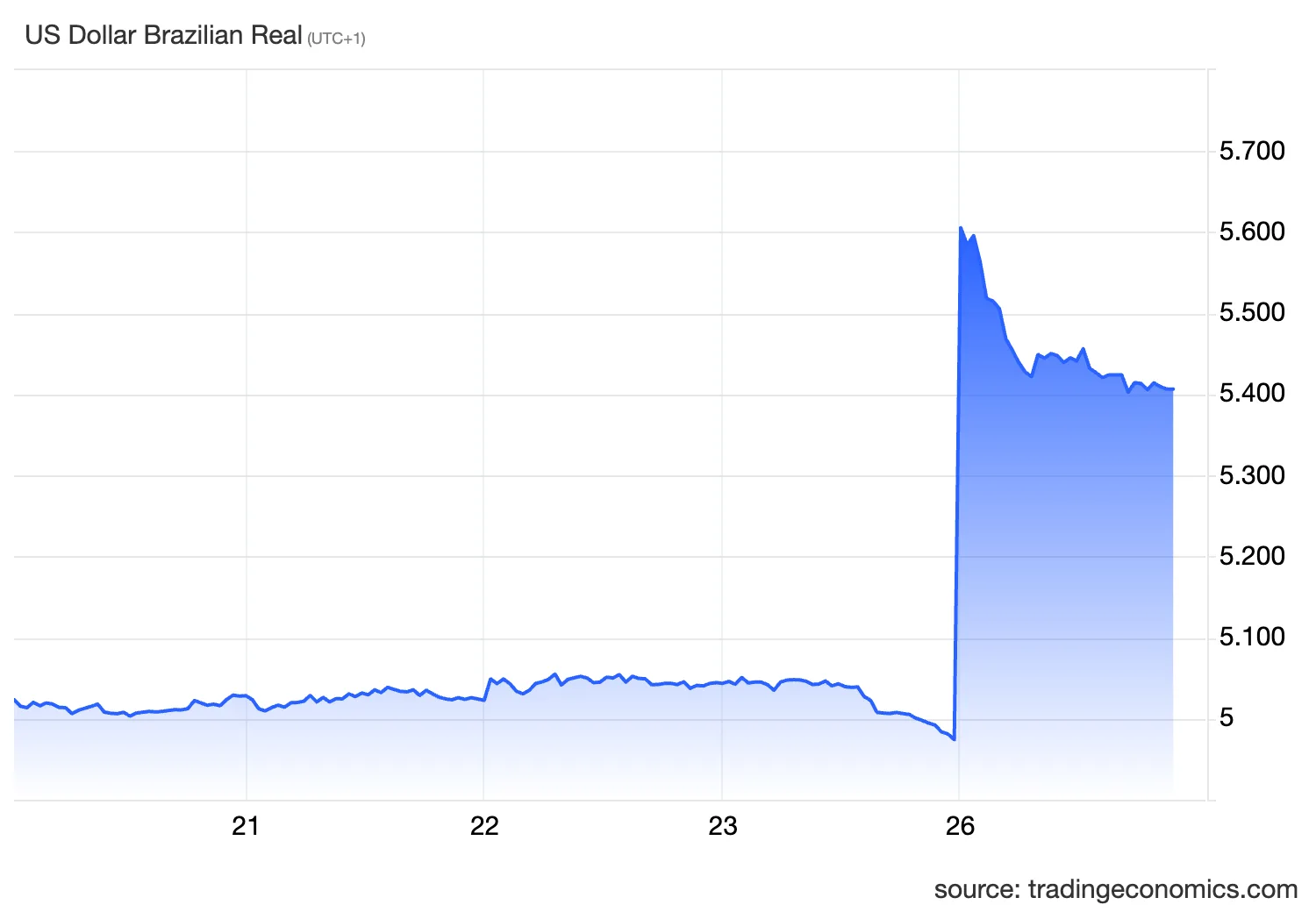
The real lost nearly 9% against the dollar on Monday. The exchange rate jumped from just under 5.00 to around 5.42 reais per dollar and rose above 5.60 during the day. It was the biggest daily move at least since 2020. Thanks to its 14% interest rate, the real was a popular currency for so-called carry trades: investors borrow cheaply in dollars or yen and invest the money where interest rates are high. When these positions are closed, a lot of money leaves the currency all at once. Other Latin American currencies took only a modest hit. The Colombian peso lost about 2.5% and the Uruguayan peso 3.2%; the Mexican and Chilean pesos barely moved. The dollar index gained only 0.2%. So it wasn’t global capital fleeing, but money leaving Brazil. Who faces this risk: anyone holding an emerging-market ETF or Latin American companies traded in the U.S. faces currency risk in addition to the risk of the companies themselves.
Brazilian stocks I’m watching: NU and MELI
I have two Brazilian stocks on my watchlist: Nu Holdings $NUand MercadoLibre $MELI. Nubank closed at 12.59 USD on Monday, down 17%, and fell as low as 11.62 USD during the day. That makes sense, since 118 of its 139 million customers are in Brazil, so a weaker real and higher interest rates work directly against it. MercadoLibre fell about 8% to around 1,670 USD and is about 30% below last year’s high of 2,361 USD. Brazil accounts for 54% of its revenue, with the rest coming mainly from Mexico and Argentina, so it’s better protected against problems in any one country. I’d start buying Nubank around 11.50 USD, near Monday’s panic low. I’d want MercadoLibre around 1,500 USD, which is about 36% below its high.
I buy companies that keep growing even in a tougher macro environment, and those prices give me a margin of safety in case the government really does ramp up spending.