These 3 Stocks Have Lost Over 80%. Which One Has a Chance to Rebound 400%?

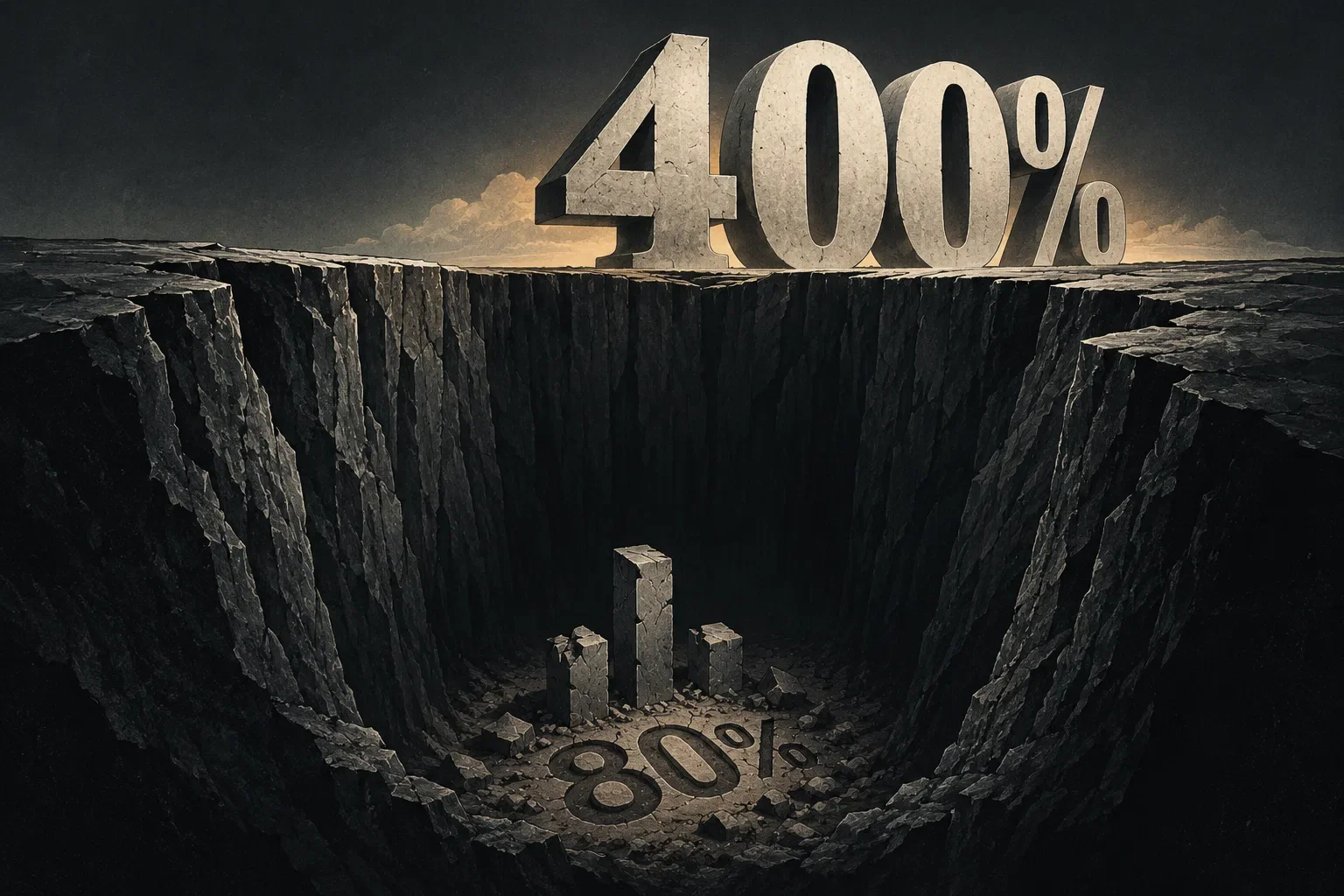
When a stock falls 80%, it has to rise 400% just to get back to its old value. Nike, PayPal, and California-based PG&E are now facing that math. Each has fallen for a different reason, and each has a different chance of recovering.
The S&P 500 has stayed near record highs this year, and most of its big names are making money. That makes the companies that stand out all the more: they haven’t fallen out of the index, but their stocks are trading at a fraction of their former value. Three of them have lost more than 80% from their peaks: sportswear maker Nike $NKE , payments company PayPal $PYPL , and California utility PG&E $PCG .
At first glance, it’s the same story: a plunge, a low price, and an enticing bet on a turnaround. But beneath the surface, these are three completely different situations. At one company, the business has stopped working; at another, the business is working, but the market has stopped valuing it; and at the third, everything depends on politics in Sacramento.
Nike | PayPal | PG&E | |
|---|---|---|---|
Share price (Oct. 16, 2026) | 37.13 USD | 56.70 USD | 13.09 USD |
All-time high | approx. 179 USD (2021) | approx. 310 USD (2021) | approx. 71 USD (2017) |
Decline from peak | approx. 80% | approx. 82% | approx. 82% |
Revenue in latest quarter | 11.2 billion USD (-4%) | 8.7 billion USD (+5%) | 5.9 billion USD |
Annual earnings per share (company estimate) | 1.15 to 1.35 USD | approx. 5.38 USD | 1.64 to 1.66 USD |
P/E based on this estimate | approx. 30 | approx. 10.5 | approx. 8 |
Nike: cheapest since 2014 and still not growing
Nike is the best-known name of the three and also the worst case. The stock has lost roughly 45% this year and is trading at levels last seen in 2014. The quarterly results released on October 1 weren’t a shock; rather, they confirmed that a turnaround will take longer than the market had hoped.
Revenue for the first quarter of fiscal 2027 fell to 11.2 billion dollars, down 4%. Nike’s own sales channels plunged 8%, and online sales fell by as much as 13%. The Converse brand lost 28%, and the Chinese market continues to decline. For the full fiscal year, the company expects revenue to fall by a high single-digit percentage.
New CEO Elliott Hill, who took over in fall 2024, also unveiled the Pace restructuring program. It is intended to save 2.5 billion dollars by fiscal 2031, but will cost around a billion dollars in severance and other expenses. The key point is that, according to analysts, the savings won’t show up in earnings until fiscal 2029 at the earliest.
“In the near term, we expect the stock to trade in a narrower range until there is more clarity on Nike’s path back to revenue growth and expanding operating margins.”
Randy Konik, Jefferies analyst, after the quarterly results on October 2, 2026
Konik is one of the optimists, still recommending that investors buy Nike, with a price target of 60 dollars. Goldman Sachs and Bank of America are on the other side, with sell ratings and targets of 27.50 and 24 dollars. Most of the four dozen analysts have a neutral stance.
The catch is valuation. The stock has lost 80%, but earnings have fallen even further. With earnings estimated at 1.15 to 1.35 dollars per share, Nike is trading at roughly 30 times this year’s earnings—a multiple the market usually pays for growing companies, not one with declining revenue. A dividend yield of around 4.4% looks attractive, but with a payout ratio above 70% of earnings, there isn’t much of a cushion. The next major test comes on November 16 and 17, when Nike presents its five-year plan to investors.
PayPal: the company is growing, but the stock isn’t
PayPal is the most unusual case of the three. It has lost 82% from its peak of 310 dollars in the summer of 2021, but its business has never stopped growing. In the second quarter, revenue rose 5% to 8.7 billion dollars, payment volume increased 10% to 486 billion dollars, and the company raised its full-year earnings forecast to 5.38 dollars per share.
At a price of around 57 dollars, that means a P/E of roughly 10.5. For comparison, the S&P 500 index average is about twice as high. PayPal has also bought back 6 billion dollars’ worth of its own stock over the past twelve months, more than 12% of its current market value.
So why is the market paying so little? There are two reasons. First, the number of active accounts has stalled at 439 million, and the key segment—payments through the PayPal button at online stores—is growing by just 1 to 2% a year. Competition from Apple, Google, and bank payment systems is immense. Second, the company is undergoing another major transformation. Since March 2026, it has been led by Enrique Lores, the former head of HP, and investors don’t yet know whether his plan will deliver more than just cost savings.
“Double-digit growth in earnings per share is the goal we have for the company.”
Enrique Lores, PayPal CEO, at the Goldman Sachs conference on September 9, 2026
Lores didn’t give a timeline, which is exactly what the market is missing. Analysts currently expect earnings to grow by around 5% a year, half the rate the CEO is promising. The third-quarter results on October 27 should provide another answer.
PG&E: double-digit earnings growth and a stock near the bottom
In terms of pure operating performance, PG&E is the strongest of the three. The utility, which supplies electricity and gas to much of Northern California, reaffirmed its earnings forecast for this year of 1.64 to 1.66 dollars per share, marking its fifth consecutive year of double-digit growth. At a price of 13 dollars, the stock is trading at roughly 8 times earnings, while typical U.S. utilities trade at twice that multiple.
But PG&E isn’t suffering because of its business; it’s suffering because of its history. In 2017, wildfires caused by its power lines began catching up with the company, and two years later it went bankrupt. Since then, California has had a state fund to cover wildfire damage, along with a liability cap for utilities. But a fire near Los Angeles in January 2025, linked to rival Edison, showed that the fund could be depleted.
Utilities therefore pushed for reform that would replenish the fund and preserve the liability cap even if the fund ran out. On August 31, lawmakers effectively postponed it, and PG&E stock plunged 20% that day. Wells Fargo and BMO subsequently downgraded their ratings. BMO also spelled out what was at stake: in an unfavorable scenario, it sees the stock worth 3 dollars; if reform is passed in 2027, it could be worth 35 dollars. The company responded by postponing 2 billion dollars in investments planned for 2027.
“If investors and banks see the risk as too high, they either charge more or don’t invest in the stock at all.”
Patti Poppe, PG&E CEO, in an interview with CNBC on September 2, 2026
Poppe also points out that the company has dramatically reduced wildfire risk over the past six years, and in early October unveiled a plan to bury 5,000 miles of power lines over the next ten years. Third-quarter results are due on October 22, and the market will be listening above all to what management says about the negotiations in Sacramento.
Three declines, three different questions
They have only one thing in common: the number. Otherwise, these are three different bets, each with a different likelihood of success.
Nike needs people to come back to its shoes. No cost-saving program can replace revenue growth, and the stock isn’t cheap at all once the drop in earnings is taken into account.
PayPal needs the market to believe that a company with a P/E around 10 and billions in buybacks won’t just stagnate slowly. The business is working; what’s missing is a growth story.
PG&E needs just one thing: a law. Operationally, it is the healthiest of the three, but the stock’s entire value depends on a vote the company cannot influence.
For investors looking for a contrarian bet, one thing follows from this: an 80% plunge doesn’t by itself mean an opportunity. It only means the market has a very poor opinion of the company—and sometimes, unfortunately, the market is right.