


One blood test to detect dozens of types of cancer. What investment potential does GRAIL hold?

The blood test that looks for more than 50 types of cancer has been sold in the US for five years and recently received support from FDA advisors. The maker's stock gained more than half in a single week. But the largest study did not prove that the test reduces the number of late-detected tumors, and the company loses roughly two and a half dollars for every dollar of revenue. It can find cancer, but it has not yet proven that it prolongs life.
Key points
The largest randomized study of the Galleri test, with 142,000 people, did not meet its primary endpoint; advanced tumors were practically the same with or without the test. Yet the day after the results were published, FDA advisors voted for approval.
GRAIL sells more than 61,000 tests per quarter, 35% more than last year. Revenue is growing only 24%, because the average test price has fallen to about $700.
The company earns roughly 48% of revenue on the testing itself. Yet in the first half of the year it burned $168 million in cash, and the share count rose 24% over the year.
Abbott sells a competing test, Cancerguard, for $689, $260 less than Galleri. But GRAIL is the only one with a randomized study and is first in line for an FDA decision.
At around $130, investors pay roughly 30 times annual revenue. None of the analysts' price targets reaches the current price; even the highest is $118.
We are talking about the California company GRAIL $GRAL and its Galleri test. The company was founded in 2016 as a spin-off of Illumina $ILMN, the maker of sequencers, machines for reading DNA. Illumina fully acquired it in 2021 and in June 2024, under pressure from antitrust authorities, spun it off again as a separate listed company. Galleri accounts for 95% of revenue; the rest comes from services for pharmaceutical companies. The test is prescribed by a physician, has been on the US market since 2021, and its list price is $949.
The stock trades around $130 on September 28, and the market values the company at about $5.8 billion.
Galleri can look for more than 50 cancers. But it detects only two of five tumors
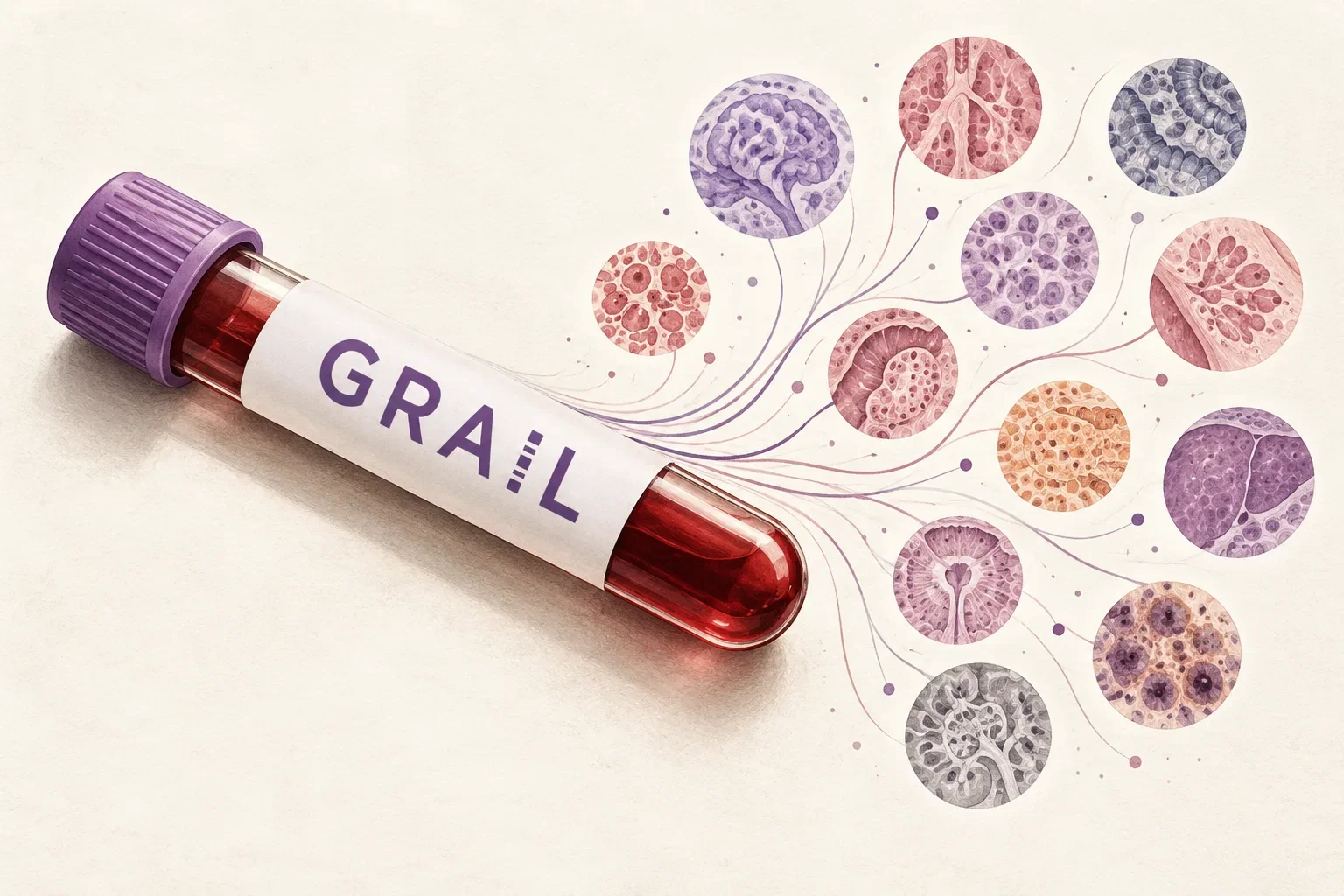
Galleri looks in the blood for small fragments of DNA that tumor cells release. By chemical marks on this DNA, it recognizes whether it comes from a tumor and estimates the organ where the tumor is growing. The physician then does not have to search the whole body and can start targeted.
How the test performs in people without symptoms is best shown by the US PATHFINDER 2 study with nearly 36,000 participants over 50. Its results were published on September 22 in Nature Medicine.
What the study measured | Result |
|---|---|
Positive results with actual cancer behind them | 60% |
People without cancer who got a false alarm | 0.4% |
Cases where the test showed the correct organ | 91% |
All tumors the test detected during the year | 39% |
Tumors of the 12 deadliest types the test detected | 70% |
When the test reports cancer, it is right in three of five cases and almost always points to the right place. But of the 440 tumors that appeared in participants during the year, it detected only 173. A negative result therefore does not rule out cancer, and the company itself states that the test does not replace mammography, colonoscopy, or other routine screening.
The test best detects aggressive tumors that release a lot of DNA into the blood and for which there is often no routine screening. Roughly three quarters of the tumors it found were such types. On the other hand, it most often misses small early breast and prostate tumors that mammography or the PSA test reveal. For the business this has two sides. Galleri fills what is missing today, but it is weakest for early tumors, where it would help the patient most.
The technology itself is not a competitive advantage; other companies use a similar principle. GRAIL has a lead in data volume and clinical evidence from the asymptomatic population. In addition to studies with hundreds of thousands of participants, the company sold over 185,000 tests in 2025 alone, and each test expands the database on which the model learns. Such data cannot be quickly bought. But what matters is whether it also yields demonstrable health benefit.
The study with 142,000 people missed its primary endpoint. Why nobody wrote it off
For investors, NHS-Galleri is the most important study GRAIL has. It was the only one that compared people who got the test with a group that did not, and it could show whether early detection leads to treatment before the disease develops. That is the evidence insurers and health systems are waiting for, the ones who would eventually pay for the test at scale. Participants in England came for blood draws three times, once a year. The logic was simple: if the test catches tumors early, after three years there should be fewer people among those tested whose cancer is discovered only at an advanced stage, when treatment is much harder.
That was not confirmed. According to results published on September 22 in the New England Journal of Medicine, the test found many additional tumors among those tested, often at an early stage. But people whose cancer was nevertheless detected only at an advanced stage were practically the same in both groups: 706 with the test and 688 without. The primary endpoint of the study, which GRAIL funded, was therefore not met. The market had known this since February, when the company published the first results and its market value fell sharply, according to its own filing.
GRAIL still sees hope in the data. Among those tested, there were about 14% fewer people whose cancer was discovered only after it had spread to other organs, and according to the company this difference grew with each year of testing. But it is only a hint. When a study misses its primary endpoint, secondary results cannot serve as full proof under its plan. GRAIL is therefore extending follow-up of participants by 6 to 12 months.
For the investment case, the key is the difference between two claims. That the test can recognize cancer in the blood and show where to look is proven. Whether it makes people die less has not yet been measured by any study, and an independent expert commentary published alongside the study concludes that the test is not ready for population screening. This proof will decide whether the test enters routine care paid by insurers, and with it the size of the market now priced into the stock.