


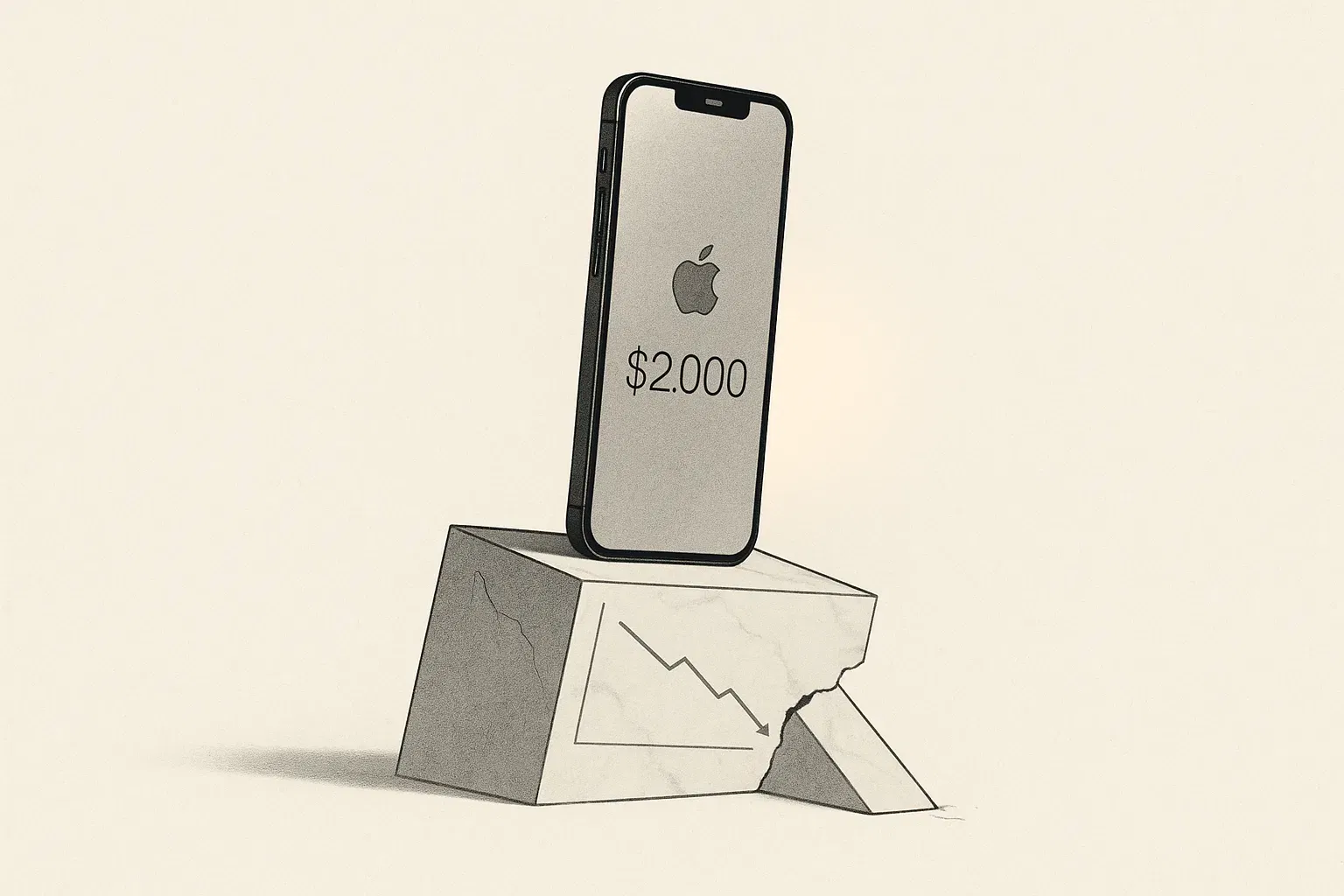
Apple showed a $2,000 iPhone, yet the stock fell. Analysts weren't surprised

Over the summer, the market added $570 billion to Apple's valuation on expectations of a folding iPhone. When the company unveiled it, the stock dropped. How much shareholders will earn from the Duo won't be decided by design, but by a component Apple doesn't make and whose price it doesn't control.
Key points
The market added $570 billion to Apple's valuation in less than three months for a product nobody could buy yet.
The stock greeted the premiere of the most expensive iPhone in history with three losing days and a two-week low.
The $1,999 price surprised Wall Street, which expected up to $500 more.
Tim Cook talks about a once-in-a-century flood in memory prices, and the bill will come to shareholders at the end of October.
Consensus analyst target is 5% above the current price
Three red days before the biggest launch in twenty years
Apple $AAPL entered the summer as a giant lagging in AI, and exits it as a company the market added over $570 billion in value to in less than three months (about CZK 11.8 trillion). Since June 25, the stock has risen about 15% from $275, almost entirely on expectations of a single product: a folding iPhone that nobody could buy yet.
But the September 9 launch itself looked different from what the headlines suggested. The stock entered it with three straight losing sessions, held about 1% down during the roughly 80-minute presentation by new chief John Ternus, and closed the day at $315.34, the lowest in two weeks and about 7% below the July 28 high. The market capitalization around $4.6 trillion (about CZK 96 trillion) equals about 36 times annual earnings. That's how you value companies from which the market expects acceleration, not just maintaining pace.
It's not surprising. Bank of America analyst Wamsi Mohan calculated that since 2007, Apple's stock fell the day after a product launch in 10 of 24 cases and rose in only nine. But 60 days after the launch, it was higher in 17 of 24 cases. So the "sell on the news, buy a month later" pattern has a long history. The question for your portfolio is whether the second half holds this year. The answer isn't in the hinge or the display, but in a price Wall Street didn't expect.
"When we compare material costs with the expected price of the iPhone Ultra at $2,000 and up to $2,500, we see that the iPhone Ultra will either slightly dilute the roughly 40% margin of the standard iPhone if priced at the low end of the expected range, or increase it if it costs $2,500."
Craig Moffett, analyst at MoffettNathanson (client note from September 8, 2026; "iPhone Ultra" was the working name for the device Apple introduced as the iPhone Duo)
$1,999: the number that will decide if the rally continues
The iPhone Duo starts at $1,999 for the 256GB version, according to the official price list, and ends at $3,199 for 2TB. Through the new Apple Upgrade leasing program, it comes to $57.99 per month, pre-orders begin October 16, and it goes on sale October 23 in more than 70 countries.
At first glance, the most expensive iPhone in history; at second, a surprisingly cheap phone. Wall Street expected a range of $2,000 to $2,500, and many estimates pointed to the high end. Ternus thus chose volume over margin with his first major pricing decision. That's exactly how Jefferies reads it, which has a sell rating on Apple with a target price of $263.66: according to them, a lower base price makes sense, but could weigh on profitability.
Why it matters for the stock follows from Moffett's calculation above: the Duo at $1,999 slightly dilutes the roughly 40% margin of a regular iPhone, and would raise it only around $2,500. Each Duo sold adds revenue to Apple, but slightly subtracts from the percentage that remains as profit from each dollar of revenue.
Optimists focus on the first half of that sentence. Gene Munster of Deepwater Asset Management doubled his estimate of the Duo's share of iPhone revenue in fiscal 2027 from 5% to 10% after the presentation. If a third of Pro Max buyers switched to the Duo, it would raise iPhone revenue by 5% and the whole company's by 2.5%, according to him. Pessimists focus on the second half and note that Apple raised the price of the iPhone 18 Pro by $100 the same day. Not on a whim. Outgoing Tim Cook named the reason very vividly.
"On the pricing front, we raised prices, I would say, reluctantly. We did it because we are in what I would call a hundred-year flood in memory prices, with exponential growth in their prices."
Tim Cook, then CEO of Apple, on the conference call for third-quarter fiscal 2026 results (July 30, 2026)
A hundred-year flood: the bill coming to shareholders at the end of October
The numbers that CFO Kevan Parekh added to Cook's metaphor are more important to shareholders than anything from the stage. Apple's gross margin reached 50.1% in the June quarter, but two percentage points of that came from one-time tariff rebates. For the September quarter, the company promises only 47 to 48%, again including one point from rebates. Without them, it's a decline from 48.1% to 46.5%, and Parekh admitted on the call that this drop of 160 basis points is more than entirely due to memory price increases.
The mechanism is as simple as for a baker whose flour got more expensive. Apple bought memory chips at old prices, and those inventories are protecting it so far. But Parekh said openly that after September the benefit of inventories will weaken, while market memory prices will keep rising. And he added a key detail: DRAM essentially has three suppliers. Their premium capacity for 2026 has been bought up by AI data centers. Samsung, SK Hynix, and Micron are selling the maximum of what they produce to Nvidia, Microsoft, Amazon, and Meta.